































Choose your area
Select a branch to view the dedicated catalog and local services
Beta Branches and Commercial Areas
 Beta Italia (HQ)
Italia, San Marino, Città del Vaticano
Beta Italia (HQ)
Italia, San Marino, Città del Vaticano
 Beta Iberia
España, Andorra
Beta Iberia
España, Andorra
 Beta France
France, Algérie, Maroc, Mauritanie, Tunisie, Guadeloupe, Guyane française, Martinique, Mayotte, Polynésie Française
Beta France
France, Algérie, Maroc, Mauritanie, Tunisie, Guadeloupe, Guyane française, Martinique, Mayotte, Polynésie Française
 Beta UK
Great Britain, Republic of Ireland
Beta UK
Great Britain, Republic of Ireland
 Beta Austria
Österreich, Deutschland
Beta Austria
Österreich, Deutschland
 Beta Benelux
Nederland, Curaçao, Caribisch Nederland (Bonaire, Sint Eustatius, Saba), Sint Maarten-Zuid
Beta Benelux
Nederland, Curaçao, Caribisch Nederland (Bonaire, Sint Eustatius, Saba), Sint Maarten-Zuid
 Beta Hungary
Magyarország
Beta Hungary
Magyarország
 Beta Polska
Poland, Estonia, Lithuania, Czech Republic, Slovakia
Beta Polska
Poland, Estonia, Lithuania, Czech Republic, Slovakia
 Beta China
China
Beta China
China
 Beta Brasil
Brasil
Beta Brasil
Brasil
 Beta USA
USA, Canada, Puerto Rico
Beta USA
USA, Canada, Puerto Rico
Regulations and categories of safety shoes
Safety footwear must comply with basic requirements regulated by specific standards, designed to ensure the safety of the worker.
There are four European standards:
- EN ISO 20344:2011 defines the general requirements and the methodology for carrying out tests on footwear designed as PPE (Personal Protective Equipment).
- EN ISO 20345:2011 specifies the basic and optional requirements for safety footwear. Shoes compliant with this standard are identified by the letter “S” (Safety), with toe cap resistance of 200 Joules.
- EN ISO 20346:2014 describes the requirements for protective footwear equipped with a toe cap resistant up to 100 Joules, classified by the letter “P” (Protective).
- EN ISO 20347:2012 defines the requirements for footwear not exposed to mechanical risks (impact and compression). Shoes compliant with this standard are classified by the letter "O" (Occupational) and are designed without a protective toe cap and anti-perforation plate.
Minimum safety requirements
The basic requirements that work footwear must meet are classified as follows:
- Toe cap resistant to impacts of at least 200 Joules
- Sole slip resistance according to at least one of the SRA requirements (anti-slip on ceramic surfaces and with detergents) and SRB (anti-slip on steel surfaces and with glycerin)
- Minimum upper height
- One of the supplementary footwear requirements
Basic requirements supplemented by:
- Closed heel area
- Antistatic properties (A)
- Energy absorption in the heel area (E)
S1 requirements supplemented by:
- Water penetration and absorption of the upper (WRU)
S2 requirements supplemented by:
- Puncture resistance (P)
- Cleated sole
SB requirements supplemented by:
- Antistatic properties (A)
- Energy absorption in the heel area (E)
S4 requirements supplemented by:
- Puncture resistance (P)
- Cleated sole
In addition to the minimum requirements, the various models of work footwear may have additional features, as shown in the following table, which brings together the basic and supplementary requirements.
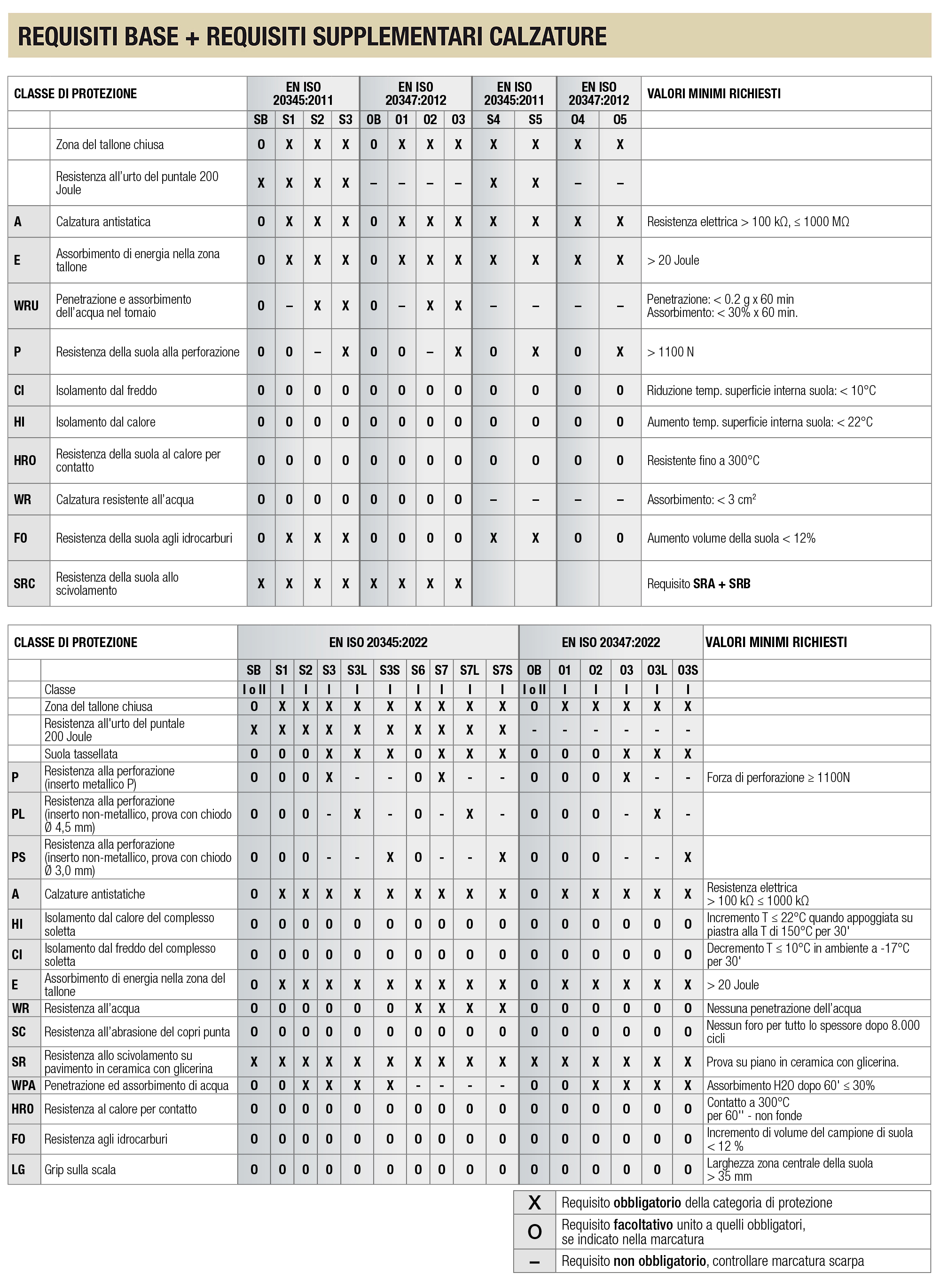
Beta safety footwear meets the different usage needs that vary according to the work sector (plumbing, electrical, mechanical, agricultural, etc.). To be sure of choosing the correct footwear, you can consult the list that groups the complete range and the requirements of each individual model.
N.B. All footwear certified under the old standard remains valid until the certificate expires.
Receive all the updates on new products, promotions, and other information from the Beta Tools world.
Subscribe to the newsletter
Official Social Media


Beta Tools Racing


- [email protected]
- Beta Tools (UK) Limited
- Unit D, Horton Enterprise Park, Hortonwood 50, Telford, Shropshire, TF1 7GZ
- Sales Tel: (01952) 677977
- VAT Reg. No. GB 4042428 90 Reg. No. 2505286 (Cardiff)