





























RU
Scegli la tua area
Seleziona una filiale per visualizzare il catalogo dedicato e i servizi locali.
Filiali Beta e Aree Commerciali
 Beta Italia (HQ)
Italia, San Marino, Città del Vaticano
Beta Italia (HQ)
Italia, San Marino, Città del Vaticano
 Beta Iberia
España, Andorra
Beta Iberia
España, Andorra
 Beta France
France, Algérie, Maroc, Mauritanie, Tunisie, Guadeloupe, Guyane française, Martinique, Mayotte, Polynésie Française
Beta France
France, Algérie, Maroc, Mauritanie, Tunisie, Guadeloupe, Guyane française, Martinique, Mayotte, Polynésie Française
 Beta UK
Great Britain, Republic of Ireland
Beta UK
Great Britain, Republic of Ireland
 Beta Austria
Österreich, Deutschland
Beta Austria
Österreich, Deutschland
 Beta Benelux
Nederland, Curaçao, Caribisch Nederland (Bonaire, Sint Eustatius, Saba), Sint Maarten-Zuid
Beta Benelux
Nederland, Curaçao, Caribisch Nederland (Bonaire, Sint Eustatius, Saba), Sint Maarten-Zuid
 Beta Hungary
Magyarország
Beta Hungary
Magyarország
 Beta Polska
Poland, Estonia, Lithuania, Czech Republic, Slovakia
Beta Polska
Poland, Estonia, Lithuania, Czech Republic, Slovakia
 Beta China
China
Beta China
China
 Beta Brasil
Brasil
Beta Brasil
Brasil
 Beta USA
USA, Canada, Puerto Rico
Beta USA
USA, Canada, Puerto Rico
Beta 1927OLS
The reversible impact wrench that does not need to be lubricated.
Maximum durability and no lubrication
Oil-less Technology
- Years of studies and internal tests have made it possible to design and engineer our first OIL-LESS impact wrench, a significant innovation in the field of pneumatic tools. The internal components are made with advanced self-lubricating materials and assembled in such a way as to significantly reduce friction, extending the tool’s service life without the need for daily lubrication.
Beta 1927OLS Video
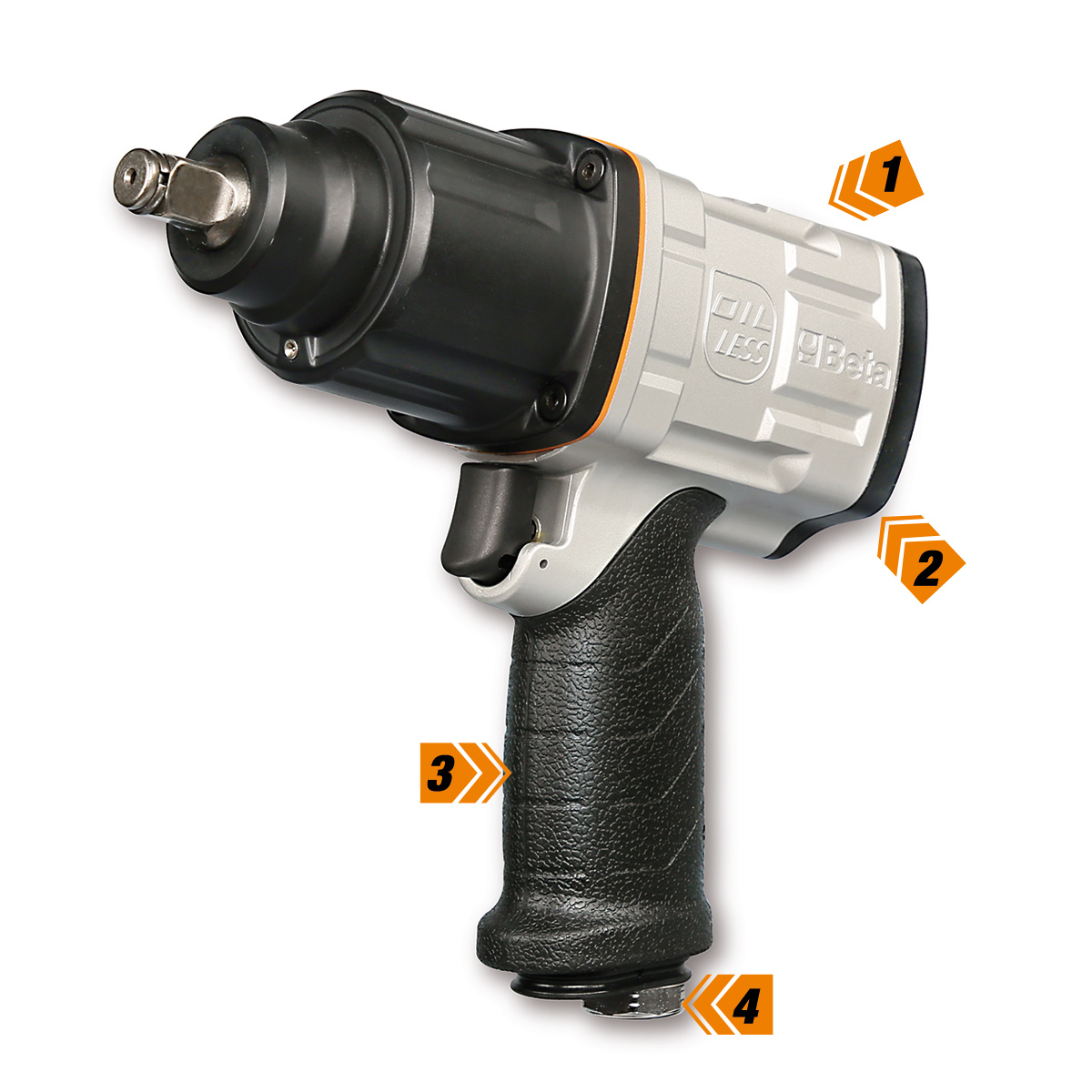
Technical features:
Beta 1927OLS
- Aluminum body: Lightweight and extremely durable.
- Power: 3 power levels for tightening and 1 for loosening
- Anti-vibration grip: Reduces stress on the hand during use for greater comfort.
- Air outlet hole: Air exhaust at the bottom of the grip for better control and greater precision.
Why choose an oil-less impact wrench?
Oil-less Technology
 No lubrication required: our oil-less impact wrench does not require the addition of lubricating oil like traditional screwdrivers, drastically reducing the need for periodic maintenance and the possibility of failures due to missing or incorrect lubrication.
 4 times longer lifespan: innovative self-lubricating materials and perfect component alignment lead to a lifespan 4 times longer than a traditional screwdriver.
 High and consistent performance over time: the absence of oil eliminates possible performance changes caused by oil deterioration, such as variation in torque or reduced effectiveness during demanding jobs, thus improving operational efficiency.
Follow us and stay updated
Receive all the updates on new products, promotions, and other information from the Beta Tools world.
Subscribe to the newsletter
Official Social Media


Beta Tools Racing


BETA AROUND THE WORLD
CONTACTS
- [email protected]
- BETA TOOLS S.P.A. - Share Capital Eur 1,000,000 fully paid-in
- Via Volta, 18 - 20845 Sovico (MB) - Italy
- Tax Code 09321470966 - VAT Number IT09321470966
- Monza and Brianza Companies Register 09321470966 - R.E.A. MB 1909778
PRODUCT SAFETY